
Monitoring high temperature processes – design challenges
To monitor processes in boilers, furnaces, kilns and reactors, maintaining optical performance in extreme heat can be a significant challenge. High temperatures, thermal shock, and the risk of material degradation all contribute to making reliable optical measurement difficult.
For high temperature applications, optical systems need to be designed to ensure performance is maintained at the application operating temperature. When a material heats up there is expansion. The rate of expansion differs depending on material types. To avoid an optical system going out of focus as it reaches operating temperatures you must take careful consideration of the rate of expansion of components and air spaces. Temperature also affects the refractive index of materials so this needs to be considered in optical designs.
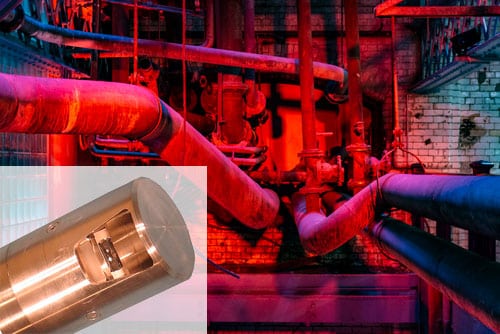
Developing an athermalized optical design, one that is insensitive to thermal change in the surrounding environment, is especially critical in the infrared spectral region. This is because the coefficient of thermal expansion of most infrared materials is orders of magnitude higher than those of visible glasses, creating large changes in the refractive index. This challenge can be resolved by using an athermal optical system. Passive optical athermalization is where the optics are designed to not change focus over a temperature range by using the different properties of the different lens materials to compensate for themselves. For more complex optical systems, our designers often use active mechanical athermalization – a technique where lenses are moved via motors to maintain focus with changing temperature.
Ultimately it is important to understand that the thermal performance of a lens can only be properly viewed in the context of an overall optomechanical system design. This should consider all the above elements of optical design, the performance of non-optical components, how optics are mounted and how the optics are positioned / oriented to the camera imaging sensor.
While standard optical systems can typically withstand temperatures of up to 350° C before a lens element coating will begin to burn off, getting anywhere near this point is a scenario to be avoided. To do this we will recommend including a cooling shroud is the design. A cooling shroud uses either water or air cooling to keep the optics safely below 50° C.
To learn more please visit https://www.resolveoptics.com/optical-system-for-high-temperature-applications/