
Welcome to the Spring 2026 edition of ‘Lens Innovation’ – a twice yearly eNewsletter from Resolve Optics Ltd. Each issue of Lens Innovation contains features written to keep you informed about the latest technological developments, applications advances and breaking news in the optical design and manufacture industry.
Please do not hesitate to contact us if you would like to comment on a particular feature or ask further questions. We welcome your feedback.

Mark Pontin – Managing Director
INFORMATION GUIDELINES:
 Monitoring high temperature processes – design challenges
To monitor processes in boilers, furnaces, kilns and reactors, maintaining optical performance in extreme heat can be a significant challenge. High temperatures, thermal shock, and the risk of material degradation all contribute to making reliable optical measurement difficult.
For high temperature applications, optical systems need to be designed to ensure performance is maintained at the application operating temperature. When a material heats up there is expansion. The rate of expansion differs depending on material types. To avoid an optical system going out of focus as it reaches operating temperatures you must take careful consideration of the rate of expansion of components and air spaces. Temperature also affects the refractive index of materials so this needs to be considered in optical designs.
Developing an athermalized optical design, one that is insensitive to thermal change in the surrounding environment, is especially critical in the infrared spectral region. This is because the coefficient of thermal expansion of most infrared materials is orders of magnitude higher than those of visible glasses, creating large changes in the refractive index. This challenge can be resolved by using an athermal optical system. Passive optical athermalization is where the optics are designed to not change focus over a temperature range by using the different properties of the different lens materials to compensate for themselves. For more complex optical systems, our designers often use active mechanical athermalization – a technique where lenses are moved via motors to maintain focus with changing temperature.
Ultimately it is important to understand that the thermal performance of a lens can only be properly viewed in the context of an overall optomechanical system design. This should consider all the above elements of optical design, the performance of non-optical components, how optics are mounted and how the optics are positioned / oriented to the camera imaging sensor.
While standard optical systems can typically withstand temperatures of up to 350° C before a lens element coating will begin to burn off, getting anywhere near this point is a scenario to be avoided. To do this we will recommend including a cooling shroud is the design. A cooling shroud uses either water or air cooling to keep the optics safely below 50° C.
To learn more please visit https://www.resolveoptics.com/optical-system-for-high-temperature-applications/
VIEWPOINT:
Combatting the global shortage of Germanium for IR lenses
 Historically the most common material utilised for Long Wave InfraRed (LWIR) lenses for imaging in the 8-14um waveband, is Germanium.
The reasons for this are simple. Germanium is a unique semiconductor material known for its exceptional optical properties arising from its high refractive index and excellent transparency in the LWIR spectral region. It is an ideal material for detecting heat signatures because it allows IR radiation to pass through while blocking visible light. Unlike conventional optical glass, which blocks infrared radiation, Germanium allows high throughput transmission to the sensor with minimal distortion. This enables high contrast, sharp focus imaging, and the ability to detect even the smallest temperature differences.
In recent years, Germanium has become scarce and expensive primarily due to China’s export restrictions (implemented in August 2023), highly concentrated supply chains, and fast growing demand for use in both optical and electronics applications.
With the aim to secure their supply chain and stabilise costs, we are seeing a significant rise in customer enquiries for LWIR lenses which do not use any Germanium within the optical system. The choice of materials offering suitable properties for LWIR wavelengths is limited but there are other options. The problem is that a lot of these alternative materials come with their own set of problems.
One of our preferred material types to turn to is Chalcogenide glasses, however these glass types are extremely soft and scratch very easy. To produce a lens that will last any meaningful amount of time, particularly in any kind of rough environment, it is important that hard protective coatings are applied to all external facing surfaces. While hard protective coatings can increase the cost of Chalcogenide lenses, the critical thing is that the materials are readily available and the costs consistent which can give the customer peace of mind that their supply chain will not fall apart due to a lack of optical material.
To learn more about our custom IR lens design service please visit https://www.resolveoptics.com/oem-design-manufacture/
TECHNOLOGY FORUM
New Fixed Focus HD lenses for nuclear monitoring 
Nuclear systems integrators provide specialised monitoring systems to enhance safety, efficiency, and regulatory compliance in nuclear facilities. The camera monitoring systems they deploy are specialized, radiation-tolerant imaging solutions designed for hazardous, high-gamma, and high-temperature environments in nuclear plants and waste reprocessing facilities.
In recent years – nuclear systems integrators have increasingly shifted from supplying analogue tube cameras to high-resolution, radiation-hardened colour CMOS sensors. The higher resolution colour images that these sensors provide delivers improved visual detail for reactor inspection and dismantling tasks.
All the non-browning lenses we supply to nuclear systems integrators utilise specially selected cerium oxide doped glass enabling them to withstand radiation doses of up to 100,000,000 rad and temperatures up to 55°C whilst maintaining good performance.
Although our existing range of non-browning fixed focus and zoom lenses will work with the high-definition CMOS sensors, the user would not be getting the most out of them. For this reason, Resolve Optics has developed the Model 419 lens.
Providing true HD quality images, the 9mm focal length Model 419 lens sets a new benchmark for close-up monitoring of nuclear applications including the integrity of hot cells, pipes, tanks, waste storage containers and reactor cores. The Model 419 fixed focus non-browning HD lens uniquely combines high performance, robustness, reliability, affordability in a compact footprint (< 20 x 35mm). This new lens is designed to provide high image resolution and minimum geometric distortion from 400 to 750nm.
Further Information: https://www.resolveoptics.com/2026/04/fixed-focus-hd-lens-for-radiation-resistant-cmos-cameras/
DESIGN FOCUS:
Benefits and shortfalls of including aspheric elements in optical designs
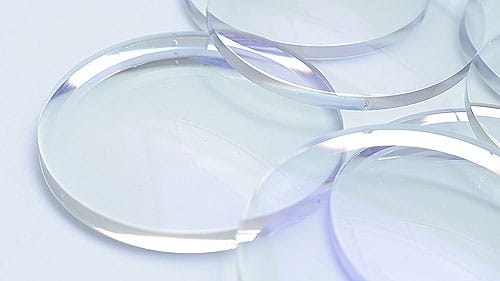 Aspheric lenses are optical components with non-spherical surfaces, designed to reduce or eliminate spherical aberrations and improve image quality. By controlling on-axis and off-axis light rays to focus on the same point, they enable optical designs with fewer elements, leading to smaller, lighter, and higher performance optical systems. Unfortunately, aspheric lenses are generally more expensive than spherical lenses, which can be a consideration when price is the key factor.
However, driven by growing demand for more compact optical products with superior imaging performance (higher resolution, minimal distortion and no spherical aberration), aspheric lenses are becoming an essential tool used by optical designers.
Aspheric lenses can be made from various materials, primarily glass and plastic. Glass lenses offer higher optical quality, better thermal stability, and durability, making them suitable for high-precision and high-power applications. If your required quantities justify it then free form moulded plastic aspheric elements are the answer to producing small zero distortion lenses with very short register.
Recently we designed a customer defined aspheric lens for a military application. The Model 524-000 is an f/1.1, 65° FOV Infrared lens that does not contain any Germanium. Designed to meet the requirements of a high-definition sensor working in the 8 to12 micron waveband, this high-performance lens uses an aspheric element to achieve the FOV whilst keeping the optical design as small as possible.
Contact our design team now for a free consultation.
PROJECT REPORT:
Flight ready camera lens for satellite missions
 In the harsh environment of space all instrumentation, sensors and cameras are subject to constant bombardment by cosmic radiation that will quickly degrade and make inoperative standard optical components.
Recently a camera manufacturer approached Resolve Optics to develop a new 6mm lens for use in space. The lens needed to be radiation resistant to withstand prolonged use in space, athermalized to deliver consistent performance across a wide temperature range and ruggedised to withstand the rigors of launch.
Due to the satellite camera manufacturers tight delivery requirements designing a new optimised lens from scratch was not an option.
Using the pre-existing optical design from our 6mm fixed focus radiation resistant nuclear lens, we redesigned the mechanics to produce a new space ready lens which would be suitable. This approach allowed us to develop a new camera optimised lens in a fraction of the time that would have been required for designing a lens from the ground up.
Designed to provide uncompromised performance on the customers radiation resistant camera the new 6mm focal length fixed focus lens delivers a high quality, large aperture (f/2) image and minimal geometric distortion from 400 – 750 nm. Manufactured to the highest quality standards from cerium doped glass, the new space ready lens can withstand radiation exposure of up to 1 MGy (100,000,000 rads) and temperatures up to 55 degrees centigrade without discoloration.
For further information on camera optimised space ready lenses please visit https://www.resolveoptics.com/space-ready-optics/
BREAKING NEWS
 Satellite optics – your questions answered
IIn a recent exclusive interview with SatMagazine – Rob Watkinson discusses our long experience of serving the satellite community with specialist optics and why our expertise in radiation resistant materials is vital to space deployment. Further he explains the importance of athermalisation, vacuum compatibility, reducing optical size / mass and the testing facilities we offer to customers to ensure reliable, longer-term high-performance operation.
To read interview in full click here.
 Bookmark this exhibition date!
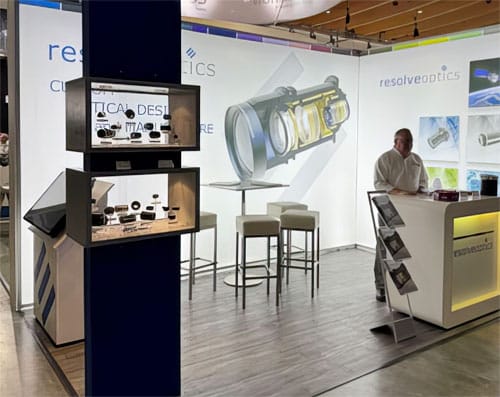
We are exhibiting at the VISION 2026 show in Stuttgart later this year. Whether you are looking for an optimised custom lens or off-the-shelf optics for your sensor, camera or instrument system we invite you to come and talk with our experienced team of specialists. Come and see us in Hall 10 Stand G44 (October 6th – 8th).
Learn more: https://www.messe-stuttgart.de/vision/en/
 In the Press: Improving aerial surveillance
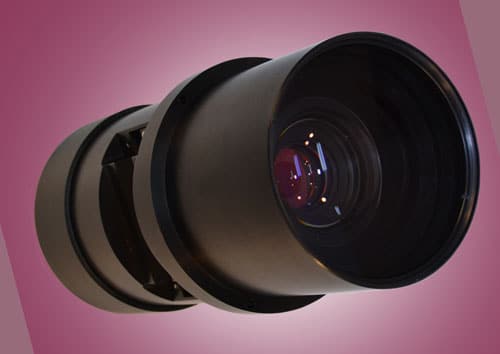
Leading optics web portal – Optics.org recently discussed how large format sensors can capture an immense amount of detail over an extremely large image. In the context of aerial surveillance, this allows operators to cover a much larger area with a single image. However, these large format sensors need a lens to provide a large image while maintaining the very high resolution typically required by surveillance applications. Thanks to the Optics.org editorial team for reporting how Resolve Optics has developed and supplied an optimized lens system designed to provide high resolution performance for a very large format sensor array used in aerial surveying.
Read feature in full: https://optics.org/product-announcements/large-format-aerial-surveillance-lens

In The Press: Trends, Challenges & QA of Custom Optics
In this Resolve Optics interview, recently published in IEN Europe magazine, we discuss technological trends driving increased use of custom lenses in high performance image processing systems. We also share valuable perspectives on tackling lens design challenges across various industries, resolving recent supply chain problems, and outlining the standard procedures and tests used for quality assurance in our custom optics.
Read interview in full: https://www.resolveoptics.com/optics22/wp-content/uploads/2026/03/ien-interview-03-26.pdf
THE LAST WORD:
What skills do I need for a career as an optical design engineer?
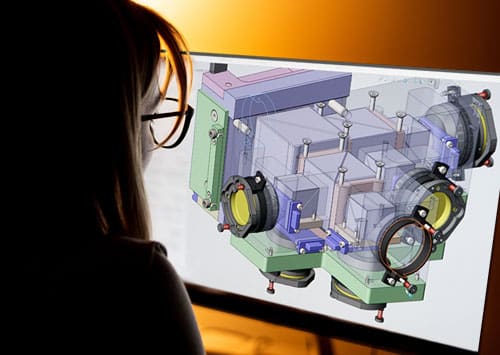 If you have a degree in Mathematics or Physics, and are interested in photography, imaging or optical design, then a career as an optical design engineer could be for you. The core competencies of a trainee optical design engineer include careful measurement and analytical skills, a good eye for detail, good communication skills, I.T competency and strong problem-solving skills. While it is possible to be trained to be an optical design engineer using our advanced inhouse optical design software, we have found the solid foundation provided by an MSc in Applied Optics invaluable. For the right candidate – Resolve Optics will fund the costs of the MSc course. We are a fast-growing company and always interested in receiving CVs from dynamic and enthusiastic people.
Send your CV now to Resolve Optics Ltd. info@resolveoptics.com