
Social Media Archive

How MTF testing is ensuring our product quality
Even using the most advanced design and manufacturing techniques, lenses and optical systems can still vary in quality. However, what every customer wants to know is that every lens we supply them...

Athermalization of optics
For monitoring and imaging applications that are subject to temperature fluctuations, it is critical to use an optical system that is insensitive to thermal change in the surrounding environment...

Looking for an alternative for ‘hard-to-source’ optics?
Are you looking to replace key optical components in your camera, sensor or instrument system that have become hard to source or even obsolete? For over 2 decades we have specialized in designing...

‘Space Project’ seeks ‘Rugged Lens’
Worried about the risk of incorporating #optics into your instrument or sensor that may fail during launch or when operating in space orbit? Look no further! Resolve Optics is a leading designer and...

How to ensure lens performance
Our technical team has written a best practice guide to provide you with useful instructions, hints and tips to assist you in getting best performance from your lenses. In order for your lens to...

Your invite to our ‘Space ready optics’ presentation
Precision optics are used in a wide variety of industrial, scientific, medical, military, and space applications. Mark Pontin, our MD, recently gave an informative ‘Space Ready Optics’ presentation...

The importance of correct lens specification.
The lens you choose controls the quality of image that’s projected onto your imaging sensor, and ultimately the quality of results your #visionsystem can produce. Image quality is a great place to...

Optics for the Nuclear industry: FAQ
Q: What does radiation resistance mean and how do optimized radiation resistant lenses maintain throughput? A: Radiation resistant, radiation tolerant, radiation hard or non-browning lenses are all...
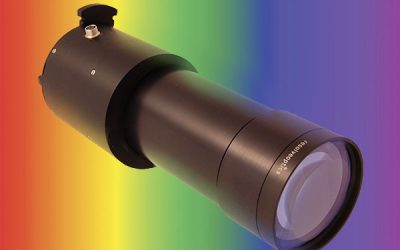
Why choose a custom UV lens?
Unfortunately, these lenses offer almost no transmission below 380 nm. For monitoring, detection and imaging applications in the Ultraviolet (UV) waveband (200 – 400nm) this is just not good enough....