
How different glass types can affect lens performance and design.
Selecting high-refractive-index glasses, such as flint glass, allows you to create thinner, lighter lenses for a given power. The downside of flint glass lenses is that they have higher dispersion leading to chromatic aberration. By comparison, lower-dispersion glasses such as crown glass minimize chromatic aberration but typically crown glass lenses are thicker for the same refractive power.
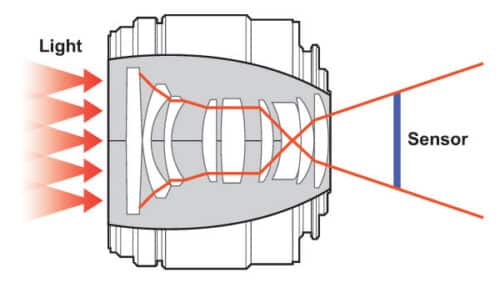
Lens designers use specific glass types and multiple elements to correct aberrations and meet performance goals. For instance, combining a positive lens made of flint glass with a negative lens made of crown glass forms an achromatic doublet able to correct chromatic aberration. The demand for higher lens performance is also driving increasing use of aspherical elements as another way to correct aberrations.
So, when you next look at an optical lens consider the way, each element has been designed to bend and refract the light to produce a high-resolution image onto your sensor. These lens elements are much more than lumps of polished glass.